When it comes to categorizing and labeling Hebrew verbs, we can do so in several ways. First, we can look at what general patterns (“stems” or בִּנְיָנִים) the verb appears. This is similar to Latin’s verb conjugations, by which nouns are categorized by the forms they take in the infinitive (whether -āre, -ēre, -ere, or -īre). In Hebrew, roots may appear generally in seven stems, though there are a few outliers here and there in peculiar stems as well, and we can label verbs as “qal” or “piel” or “hiphil” (or whatever stem they appear in by their nature).

Another common way to group Hebrew verbs is by the gutturals or vowel letters that they contain and the position in which they are found in the root.

The guttural letters are ʾalef (א), heh (ה), ḥet (ח), and ʿayin (ע). Resh (ר) is sometimes included in the list because it behaves similarly to them. The vowel letters (know in Latin as matres lectionis) are heh (ה), vav (ו), and yod (י). Notice that heh is both a guttural and a mater lectionis (sg. of matres lectionis). Since nun (נ) tends to assimilate into other letters, many roots with nun are also considered weak, depending on its position in the word. When these letters appear in a root, they mess up the normal pattern, and those mess-ups are predictable and regular.

Continue reading “Doubly Weak and Proud of It!”

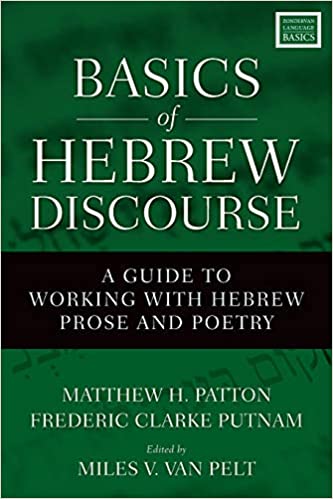
Patton, Matthew, and Putnam, Frederick. Basics of Hebrew Discourse: A Guide to Working with Hebrew Prose and Poetry. Edited by Miles Van Pelt. Grand Rapids, MI: Zondervan, 2019.

In October of last year, I pre-ordered a copy of Patton and Putnam’s much acclaimed book on discourse analysis principles as they relate to biblical Hebrew (pictured to the right). Book Cover: Basics of Hebrew Discourse (click to enlarge)I picked it up and read quickly through it in the first week that I had it. It’s certainly not a disappointment!

The first thing that you notice about the book is its compact size. It is definitely smaller than I expected, especially given the way that Zondervan has taken to making their language series books inordinately large lately. I didn’t pay attention to the dimensions when I placed the order, so I expected to hold in my hands a volume about as large as the recent editions of Basics of Biblical Hebrew and Basics of Biblical Greek. This book is nothing like those. You can easily toss it in any handbag to take it with you to the coffee house (once we’re on the other side of the COVID-19 restrictions—may it be בִּמְהֵרָה בְיָמֵ֫ינוּ [soon in our days]!) to sit and read at your leisure and then take back home to mull over and work through the examples on your own.

Continue reading “Basics of Hebrew Discourse – A Review”

Dr. Stephen Krashen talks and writes a lot about the importance of free voluntary reading (FVR) in the process of second-language acquisition. Check out the following video of a lecture he gave in Hong Kong on the value of stories in acquiring a language.

When it comes to free voluntary reading, you have several types of literature that you can choose from in order to increase the exposure you have to the Hebrew language.

Continue reading “Free Voluntary Reading (FVR) & Hebrew”

The following is the first English-to-Hebrew drill from Exercise 32 of Weingreen’s A Practical Grammar for Classical Hebrew. Participation in the translation drills dropped off, so I’ve decided to continue on my own. My dear friend Jonathan is welcome to post his work as a comment on this blog post, but I’m not going to continue to post the threads on B-Hebrew when no one seems interested. Perhaps this is a personal task that I will need to go forward on alone (or with Jonathan).

Continue reading “Weingreen – Exercise 32 #1”

You may know that I’m currently leading a group through a study of The Basics of Biblical Aramaic (BBA) from the Zondervan Language Basics series. Last week we covered chapter 9, which you can view here on our YouTube channel (youtube.com/thehebrewcafe).

You may also be aware of the project known as the Daily Dose of Hebrew  (DDH), which is currently working through Deuteronomy chapter 7. I happened to passively listen through their playlist of Deuteronomy chapter 5 while working on other things online today, and once I got a chance I decided to just open up the chapter and read through it on my own. The following verse (5:23 or 5:27, depending on your version [DDH Video]) jumped out at me because of a connection to what we covered in Aramaic this week:

Deuteronomy 5:23 (Hebrew = 5:27 in Christian Bibles)

קְרַ֤ב אַתָּה֙ וּֽשְׁמָ֔ע אֵ֛ת כָּל־אֲשֶׁ֥ר יֹאמַ֖ר יַהְוֶ֣ה אֱלֹהֵ֑ינוּ וְאַ֣תְּ ׀ תְּדַבֵּ֣ר אֵלֵ֗ינוּ אֵת֩ כָּל־אֲשֶׁ֨ר יְדַבֵּ֜ר יַהְוֶ֧ה אֱלֹהֵ֛ינוּ אֵלֶ֖יךָ וְשָׁמַ֥עְנוּ וְעָשִֽׂינוּ׃

Notice that the expression וְאַתְּ תְּדַבֵּר “and you shall speak.” This looks like grammatical discord. We would expect to see either וְאַתָּה תְּדַבֵּר‎ (2ms) or וְאַתְּ תְּדַבְּרִי‎ (2fs), but what we actually see seems odd.

Continue reading “Aramaic and Hebrew Personal Pronouns”

Or: Weingreen English-Hebrew Translation, Exercise 31, Number 6

I’ve mentioned before that we are doing English-to-Hebrew translation exercises from Weingreen’s A Practical Grammar for Classical Hebrew as entertainment, not as a formal study. I figured that I would post the exercise that I have just posted on B-Hebrew and give you some insight into what goes into my thinking when I produce my translations. You are free to comment and let me know if you agree or disagree with my decisions and why.

Continue reading “How I Go About My Translations”

It might surprise some to learn that I have more in common with Nehemia Gordon than not. After all, I spend a lot of time talking about why I believe he is wrong about the pronunciation of the Tetragrammaton. It’s truly not a feud that I have with him personally, since I would agree with the great majority of his stances on biblical issues (as far as I’ve understood them). In this post, I want to enumerate the ways in which I agree with Nehemia Gordon so that people don’t think that I oppose everything he has to say.

Continue reading “How I Agree with Nehemia Gordon”

This is the recording of Encounter 17, covering the seventeenth chapter of Learning Biblical Hebrew by Kutz & Josberger. In this encounter, we wrapped up the first course in this two-course program. This week we are doing our final exam before giving out certificates, and then we’ll take a couple of weeks just to read from the workbook (hopefully, two sessions per week).

The new course (HE102) will begin after those couple of weeks of reading. Keep your eyes peeled for the beginning of the new course!